
Our island restoration is limited to what happens on land, but we’re not immune to interesting stories about the surrounding sea, and the intertidal zone which is the focus of this article. It’s always nice to see that there are still reasonable numbers of fishes in the very outer Sounds area, and seals, dolphins and orca add excitement. The south end of Puangiangi is a traditional spot for catching blind eels, and Roma Elkington has explained to me how to remove the copious slime from these delicacies. On the sea floor nearby are bryozoan beds (see for example this report by Rob Davidson).
At the shore on the more sheltered western side, I was struck by the lack of crabs and shellfish and put it down to the type of habitat available, but we had the opportunity for an expert assessment when Mike Bradstock visited in March 2022. On safety grounds Mike had to confine his study to the western side also. It is likely to be very different on the eastern side but it would be a mission to find out.
The best way to present this topic I think is to reproduce Mike Bradstock’s report. Take it away, Mike:
Introduction
Four transects (two each at Boatshed Bay and Woolshed Bay) made on 7 to 9 March 2022 all revealed a rather sparse flora and fauna on tidal shores facing southeast to southwest in moderate shelter. Shores on the eastern side, in greater exposure, were not surveyed. Species were identified from Cook (2010), Nelson (2013) and Morton & Miller (1968).
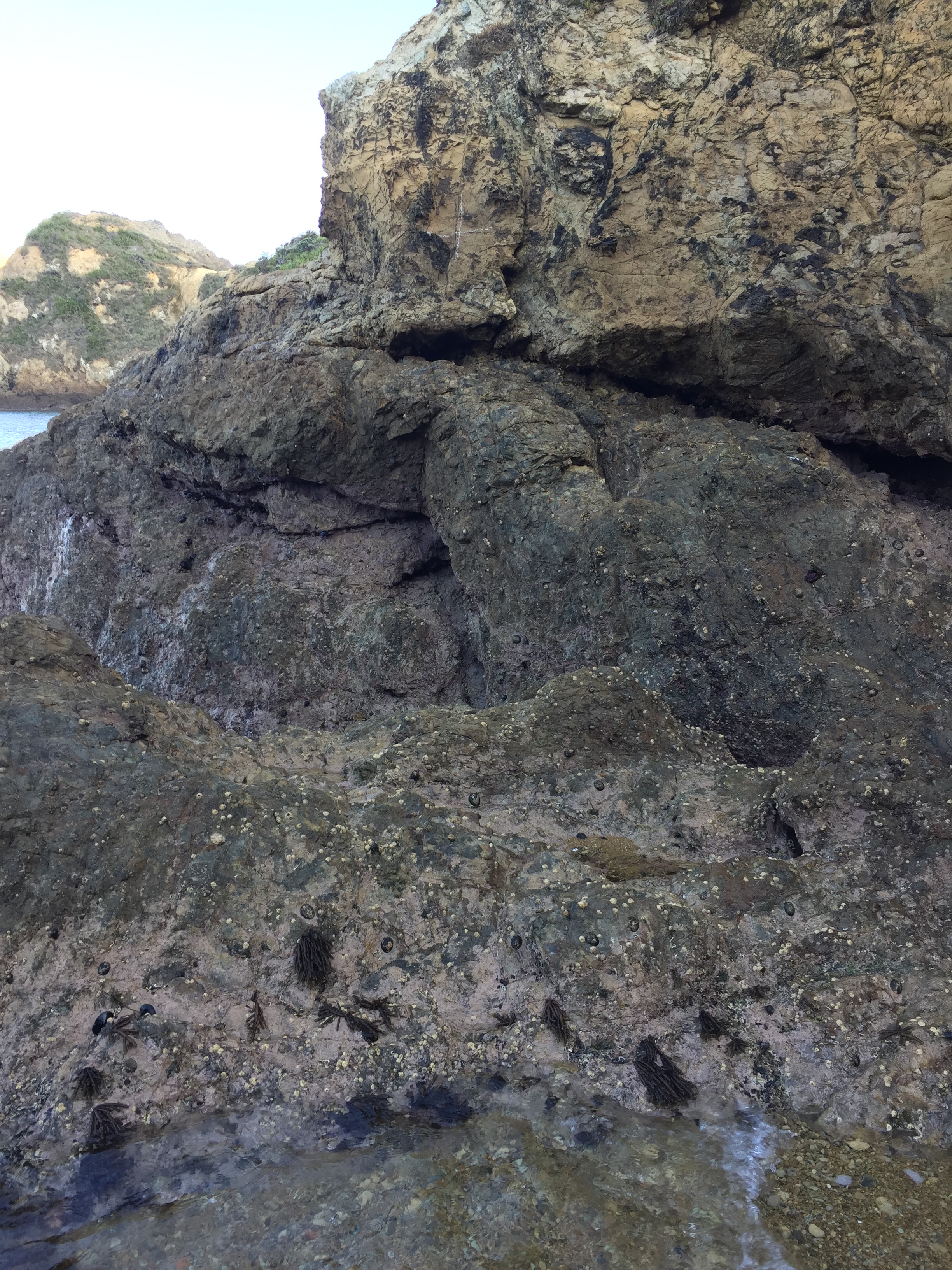
The main species found and their distributions are presented below. The shores examined were mostly rocky (country rock) and near-vertical at high water (HW), with sloping rocky or sandy beaches below. Outcrops of country rock, loose rocks, stones and cobbles were widespread across the shore profile and there was sand at many levels.
The vertical distribution of organisms at different sites (Appendix 1) did not greatly vary and suggests the degree of exposure was not much varied. Overall, I did not find any major surprises of species presence or absence, and did not see any adventive marine species either in situ or washed ashore. There was a general paucity of species, particularly red seaweeds, and intertidal organisms that typically form well defined zones on the shore (e.g. barnacles and seaweeds) were not abundant. This overall picture was more like Tasman Bay and the enclosed shores of the Sounds than the shores of Cook Strait, but generally fed with more oceanic water flowing north and south.
A species list is given as Appendix 2.
A generalised profile of the tidal shore
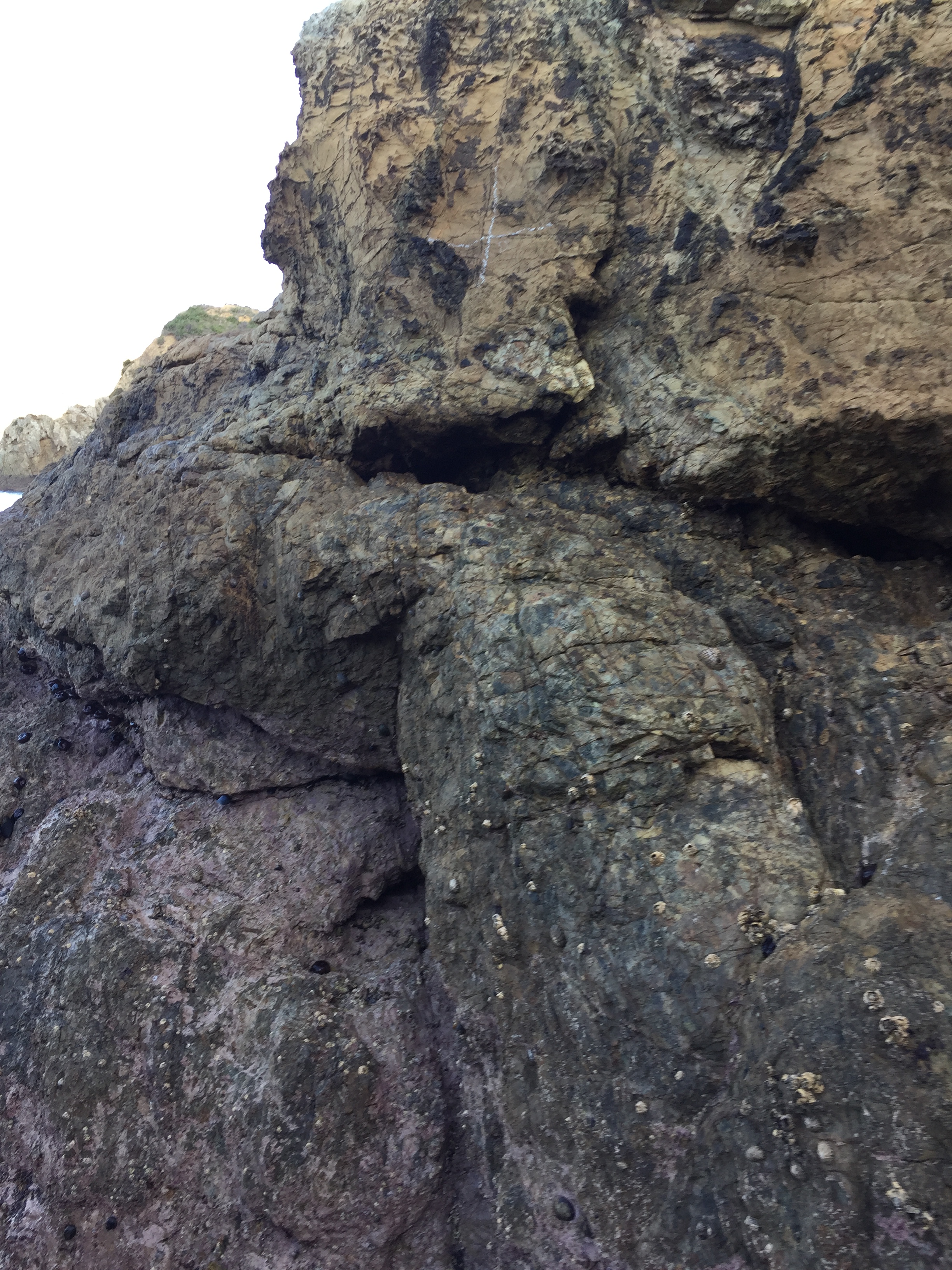
The substratum at HW (as measured in relation to strandlines on the beaches) and down for the first 0.3 m has few visible organisms except two species of tiny periwinkle: the abundant blue-banded Austrolittorina antipodum and the less common brown A. cincta, followed by the snakeskin chiton Sypharochiton pelliserpensis. The highest barnacle on the shore is Epopella plicata, and the large limpet of the middle and upper shore, Cellana denticulata, is conspicuous by its size and high-pitched shell if not by numbers. The barnacles grow individually and in small clusters but cover only a fraction of available space and are too few by far to form a distinct barnacle zone as seen on similar shores in northern NZ. Distribution of the modest barnacle Elminius modestus is patchy and lower on the shore.
The limpets Cellana ornata and C. radians appear at about mid tidal level and extend about a metre lower.
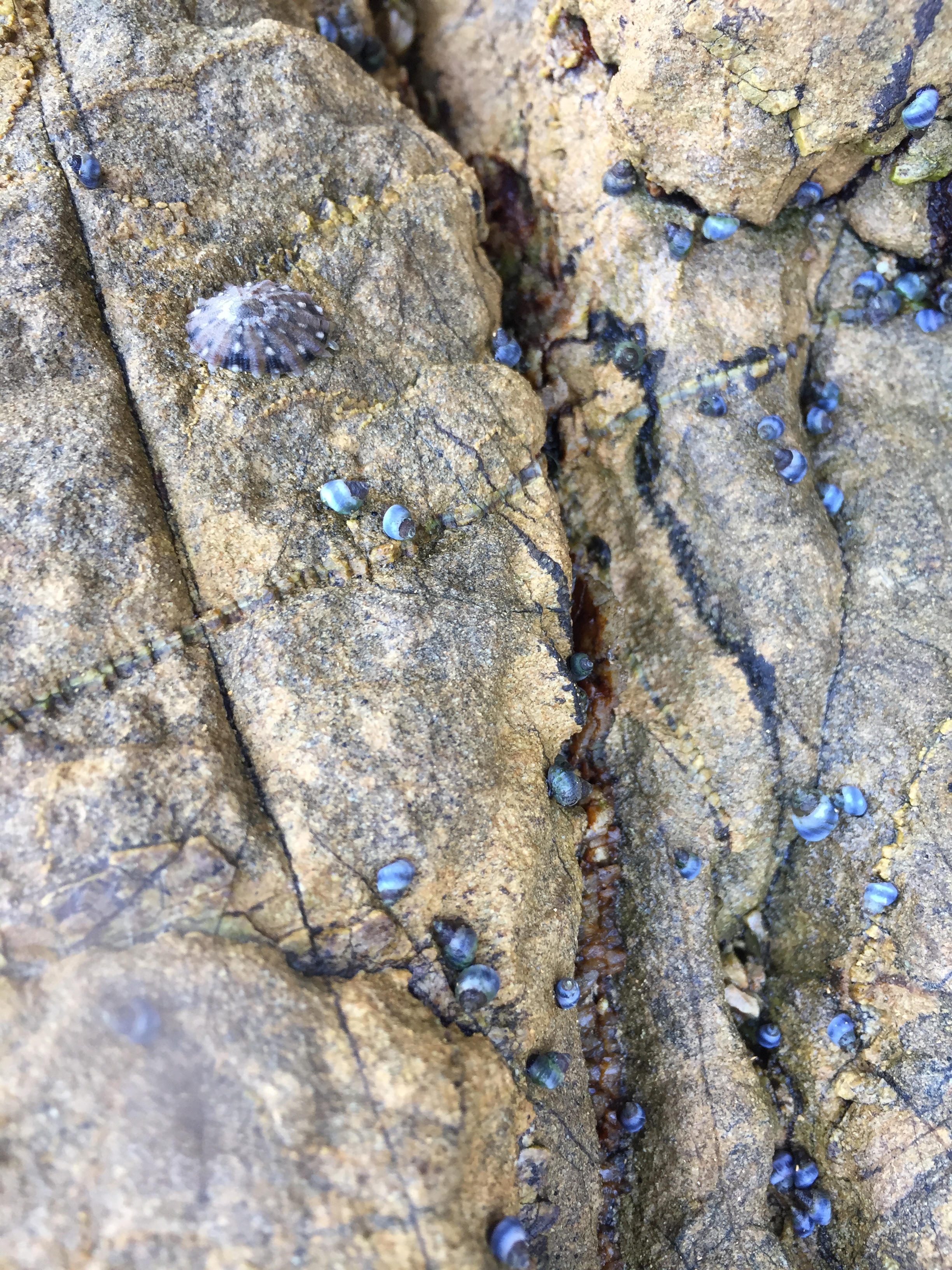
The only seaweeds seen on the upper shore were sparse karengo, Pyropia sp. (formerly Porphyra columbina) in well sunlit places among periwinkles, chitons and barnacles; and sparse small plants of Ulva (formerly Enteromorpha) compressa, mostly in moist crevices. The encrusting red alga Apophlea sp. is common and widespread on country rock and boulders.
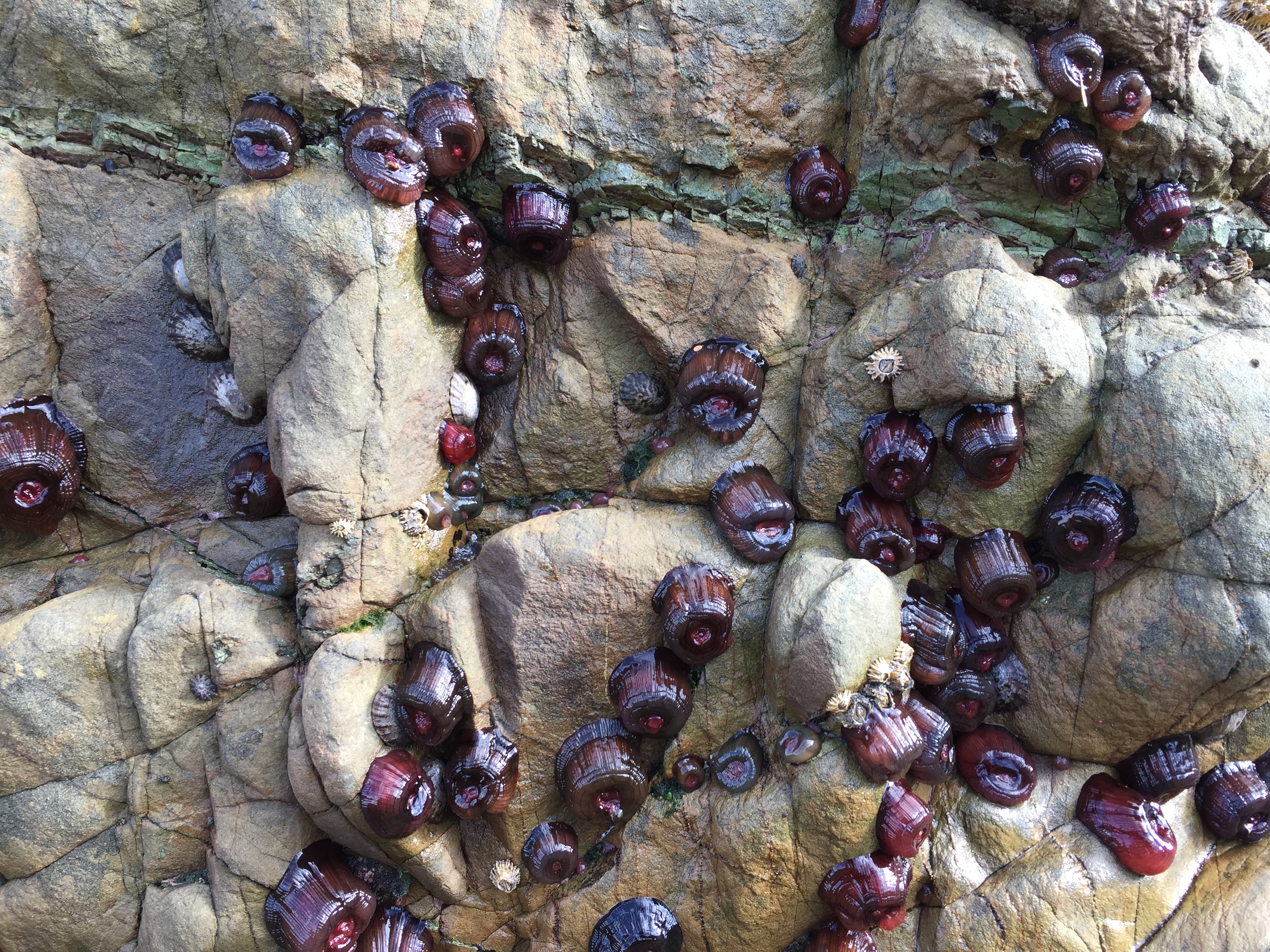
Immediately below is a conspicuous though moderately narrow zone (less than 0.75 metre) of locally abundant red beadlet anemones, Actinia tenebrosa. They are crowded in shaded or wet locations including crevices and pools and rock overhangs, and occur individually or in small groups on the most exposed surfaces. They probably comprise the largest biomass of any shore species here and reflect the effectiveness of tidal currents in providing food-rich water for filter-feeders. They might well be considered the most interesting feature of these shores.
From about this level to the lower shore the spotted black top shell Zediloma aethiops is locally abundant, especially under stable rocks, where densities reach over 1,000/m2 (small ones). The largest ones are lowest on the shore though in some places they are scarce. Tide pools at this level contained rather stunted plants of Jupiter’s necklace seaweed Hormosira banksii, with coralline algae and the cat’s eye snail Lunella smaragdus. Apart from small amphipods under rocks, intertidal crustaceans were very scarce, with rare Hemigrapsus edwardsii and Petrolisthes elongatus.
Blue and green mussels (Mytilus edulis and Perna canaliculus) occur in infrequent patches, especially in sheltered crevices, the former slightly higher on the shore and more abundant. They are not abundant enough to form a distinct zone (possibly owing to human predation).

Around and below the mussels, Corallina officinalis (coralline “paint” and “turf”) form a more or less distinct zone demarcating the lower shore and extending to low tide mark, or low water (LW). The barnacle Epopella extends as far down as this zone, where it is frequently encrusted by Corallina. At this level there is a distinct narrow belt of the brown seaweed Splachnidium rugosum. Red seaweeds, usually a feature of moderately exposed shores, are strikingly absent below this zone.
The subtidal
Low tide mark is delineated approximately by the large brown seaweeds Carpophyllum maschalocarpum (flapjack, slightly above and below LW) and C. flexuosum (at LW and extending to several metres deep subtidally). The main seaweed biomass by far is C. flexuosum, forming dense beds (a “seaweed forest”) buoyed by its small round floats.
Lunella extends into the shallow subtidal, frequently on the fronds of seaweeds. The limpet Cellana stellifera appears about low tide mark. Other molluscs at and below this level include paua (Haliotis iris and H. australis), Cook’s turban shell Cookia sulcata (all sizes including very large specimens grazing among seaweeds on country rock) and the red topshell Cantharidus purpurea grazing on seaweed fronds.
The range of fish species seen was rather narrow and included a few blue cod (Parapercis colias) over rocky open ground, abundant spotties (Notolabrus celidotus) including many juveniles and adult females in weedy and rocky areas, and large schools of the oblique-swimming blenny Forsterygion maryannae in and around rocky crevices and over seaweed. beds. A few female banded parrotfish (Notolabrus cincta), marblefish Aplodactylus arctidens, and a single short-tailed stingray (Dasyatis brevicaudatus) were seen. I might have expected but did not see butterfish, blue moki, red mullet, sweep, yellow-eyed mullet, kahawai and more species of triplefin. These and other fish species are likely also present.
Schooling fish, especially kahawai (Arripis trutta) and jack mackerel (Trachurus spp.), are known to form visible surface schools in the area, but together with marine mammals and seabirds are beyond the scope of this survey.
References
Cook S de C, ed. (2010) New Zealand coastal marine invertebrates. Vol. 1. Christchurch: Canterbury University Press.
Nelson, W (2013) New Zealand seaweeds. An illustrated guide. Wellington: Te Papa Press
Morton JE, Miller MC (1968) The New Zealand Sea Shore. Auckland: Collins.
Appendix 1: some examples of tidal range of shore species
Appendix 2: species list
Discover more from Fauna Recovery New Zealand
Subscribe to get the latest posts sent to your email.
 Fauna Recovery New Zealand