
Our 2015 lizard survey identified striped gecko as a species that should be moved to Puangiangi. At the time they were known from Takapourewa and Te Pakeka (Maud Is, formerly Te Hoiere) and have since been found on Arapaoa, all in the region. It’s logical to assume they would have been on Puangiangi as well. They are unlikely to adversely affect other lizards already there, and as they are Nationally Vulnerable, another population would help their survival. This was to be the first ever translocation of striped gecko and it became more urgent when mice invaded Te Pakeka, making an “insurance” population a good idea. Dan Palmer got the translocation proposal over the line quickly, with endorsement by Ngati Kuia (Te Pakeka) and Ngati Koata (in whose rohe Puangiangi lies).
Jo Monks has found that hard releases of lizards may be less successful than soft releases, and she reckoned we needed to make an enclosure to hold them for three months after release day so they would not disperse randomly, but rather take the time to get to know the site and be much more likely to encounter others of their species. Peter identified a 1000 sq m area with a nice diversity of shrubland species that might not be too onerous to fence. The specified fence was sheet polythene, buried to 20 cm and a bit under a metre above ground, clipped to wire strung on driven waratahs. We were skeptical though and thought the wind might destroy the fence pretty quickly. Peter started work on the fenceline in October 2018 and it was completed in January 2019 by him, volunteer Philip Leith, Dan Palmer, Aubrey Tai and Phil Clerke (both DOC).

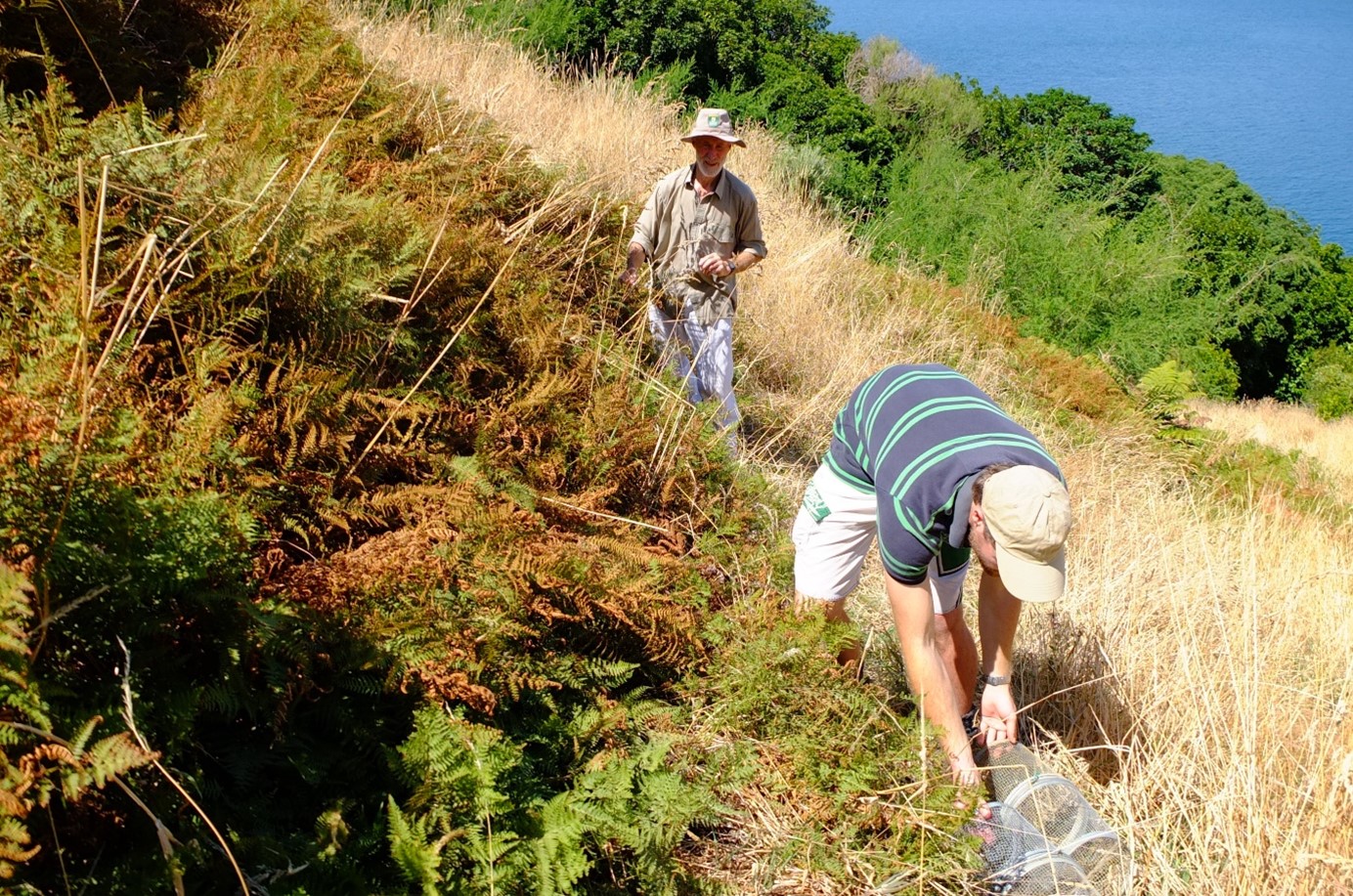
Meanwhile, over on Te Pakeka a large team led by Les Moran was catching striped gecko, initially for disease screening and then for transfer. They caught them using Gee’s minnow traps, another trap made from mesh wastepaper bins and plastic funnels, and by hand.
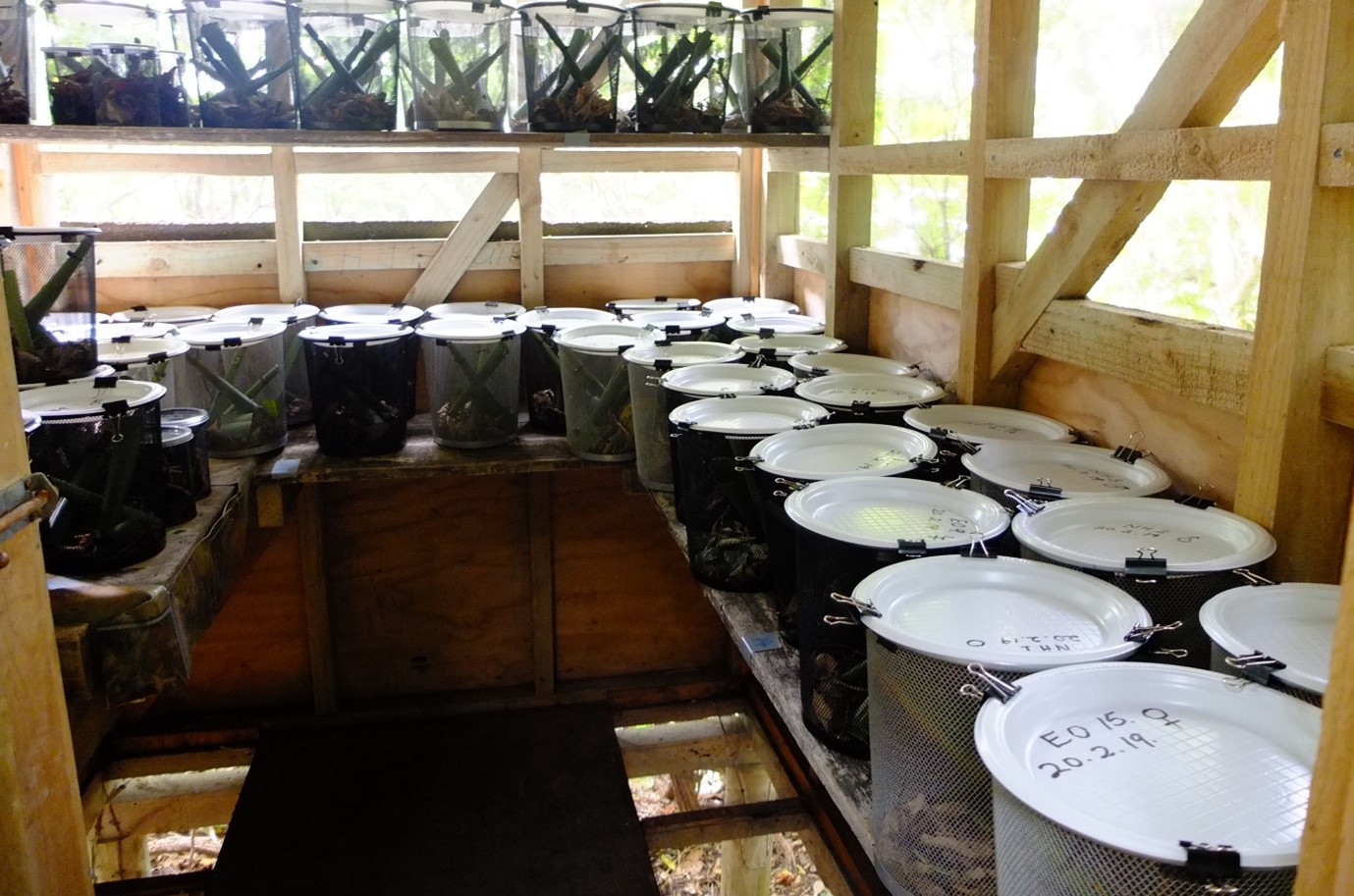
The animals duly passed disease screening and the team brought 100 over to Puangiangi on 26 February 2019. The release enclosure had suffered already in the wind but we made some temporary repairs for the day and added some horizontally buried waratahs later in the week, which held it together without breach for well beyond the required three months.
While welcoming the catching team and local friends I had to gloss over the big weka (a likely predator of the lizards) that had taken up residence in the middle of the enclosure for the day. Ammon Katene and Ngawai Webber gave korero and karanga in welcome of the animals and everyone got to spend a bit of time with the geckos while releasing them. I caught the weka that evening and it was probably the worst behaved of all we have kept in the shed prior to release on the mainland.
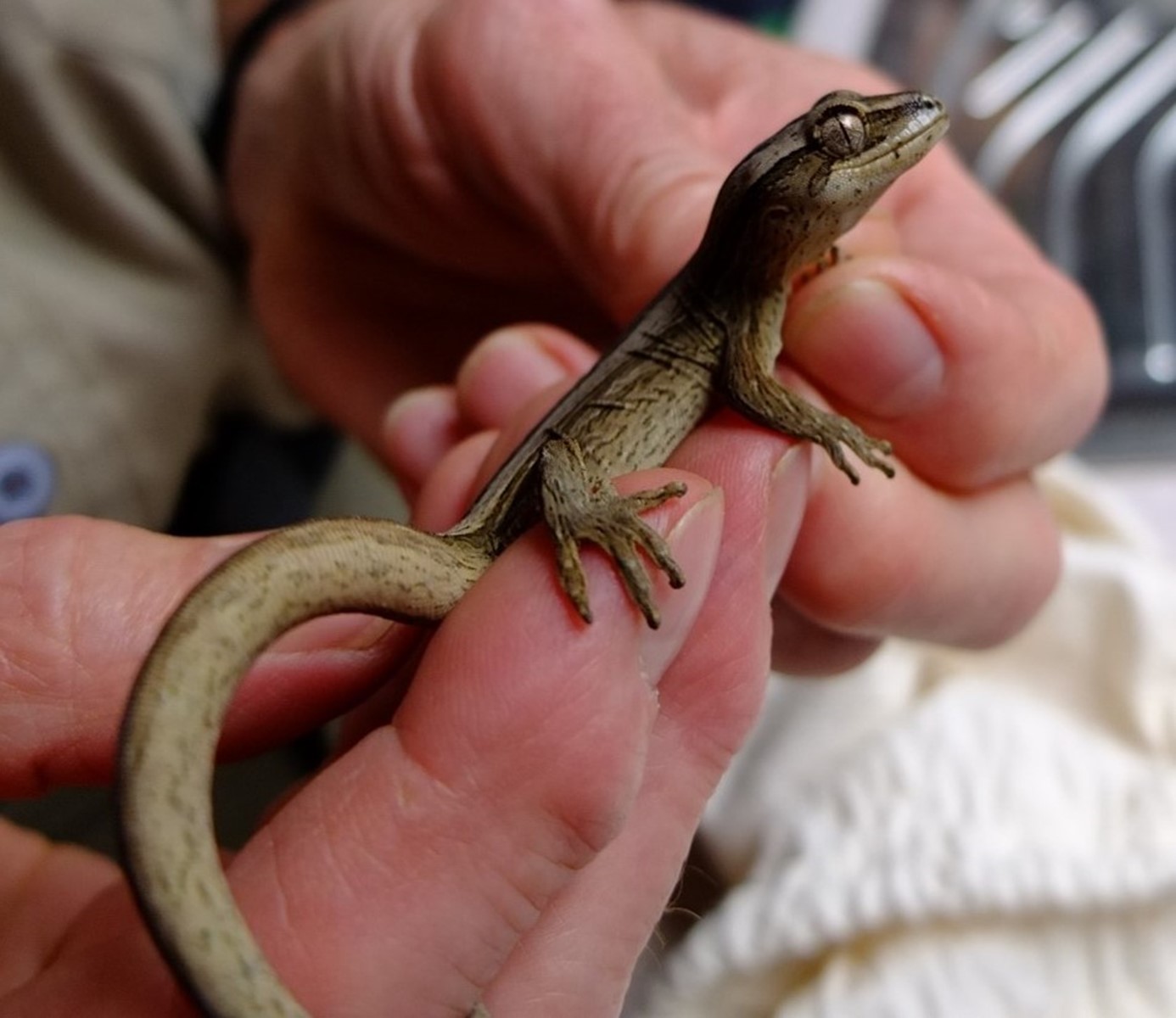
It’s usually a guess whether lizard translocations have been successful. The animals are often nocturnal and always good at hiding. You are really only likely to know if a project has been successful decades later when numbers have built up. There are many thousands of common gecko on the island judging by how many you can find in their communal refuges, but it is not that easy just to walk around at night and find them out feeding, which we would have to do for the 100 striped gecko founders. Indeed we have failed to see striped gecko on several night visits to the release site. Similarly we have seen Duvaucel’s gecko only half a dozen times since their release but have no reason to believe they are not thriving.
I was keen to see if we could put out an unattended camera to monitor for striped gecko instead. We pointed an IP security camera at a flowering koromiko at the edge of the release site, powered it from the house over several hundred metres of ethernet cable and left it for a month. Geckos were recorded over several nights, all of which looked stripey to me. I sent the footage below to three lizard experts, without explanation, and they were all able to distinguish the striped gecko from other possible lizards. The gecko had other ideas than to take nectar from the flowers: the footage at the end is slowed down to a fifth of normal but the gecko is still too quick to be properly observed taking the moth:
Perhaps this indicates that unattended IP cameras have a role in wildlife detection. A possible future step would be to equip the cameras with AI object detection and classification using, say, a trained lizard model. This technology is very nearly upon us.
What I like about this project is that it turned on its head the usual practice around the country of a group deciding, on good evidence or just a “want”, to prepare for a species translocation and then encouraging DOC to react to that. Particularly at the final Approvals stage, this process is broken and has been for some time. Like everyone, we want that fixed, but in this case we left it to the lizard survey team to decide what they wanted to happen. Then a capable person within DOC was able to progress it as an “internal” project, whatever difference that does or ought to make to the process, helped along no doubt by mice-induced urgency at the source site.
Discover more from Fauna Recovery New Zealand
Subscribe to get the latest posts sent to your email.
 Fauna Recovery New Zealand