Lizards

Our first night on Puangiangi, 31 April 2012, was frightening. It wasn’t the scary 12-volt electrics, which were way dodgier than anything William Heath Robinson might have concocted, or getting to grips with how the water might be directed to the inside tap, but rather the things that went bump in the night.

That day, we had arrived with the locksmith, gained entry and gotten to understand the infrastructure as best we could in the fading light, eaten and went to bed. Soon enough a lot of thumping and scrabbling came from the ceiling and walls of the house. This was frightening as it could have meant that Peter’s hard work in 1999 to eradicate rats had been undone. It turned out though, that this is possibly what walls and ceilings are meant to sound like on the mainland, if they were full of geckos.

Poking around the following day, we discovered that all the geckos were common geckos (now raukawa gecko, Woodworthia maculata), and that they liked the shed as well as the house. There was not a box or a nook that didn’t house a gecko, or several. Our tools and gear in the shed now need a regular clean lest they disappear beneath piles of sticky gecko droppings. They are also numerous in piles of corrugated iron outside, and Ross Webber’s various mussel-float constructions are popular too. It was a bit of a party trick to show visitors the hundreds of geckos gathered under a corrugated iron stack, but Lynn Adams and I got a shock when a robin showed up and began swallowing not-so-small geckos whole when we lifted the iron.They also get into our various rainwater drums scattered about the island to provide water for birds, and often could not climb out and drowned, until we worked out they needed a length of rope coming out the top of the drums to escape by. Dad was quite taken when he visited by the sight of little gecko faces peering over the edge of the spouting on the house, where they would gather at night probably to get a drink of the dew collecting from the roof. A look on tree trunks at night will show them on their way to catch insects, or take nectar and fruit. We’ve also seen them in the house in the daytime popping up from gaps near the windows to try to grab flies on the glass. At this time of year they are pretty torpid on the cool mornings, and they need careful rescuing if we are opening and closing doors and find them in the cracks. They wake up within a few seconds when given some warmth from a hand, and make a break for it. Peter noted only a few common gecko when he first visited Puangiangi, and the recovery since rat eradication has been explosive.

A sunny day early on soon also revealed glossy brown skink (Oligosoma zelandicum), and northern grass skink (Oligosoma polychroma). These common skinks certainly should be there, but we often remark that numbers seem quite low compared with what we have seen on similar islands, and are also a surprisingly low proportion of the known lizard population. Late summer, however, shows good numbers of young skinks in the grass. Perhaps the adults are more circumspect given the moderate numbers of kingfisher around, or maybe sunny skink habitat is slowly shrinking as the pasture becomes more rank and is taken over by shrublands.

GlossyBrownSkink
Glossy brown skink. Note vertical markings around the jaw, and brown iris. Photo courtesy Ivan Rogers.


NorthernGrassSkink
Northern grass skink. Note the strong brown and cream lateral lines, straw-coloured iris and blunt snout. Photo courtesy Ivan Rogers.

What else should be there? Forest gecko would have a similar ability to common gecko to persist in the face of rat predation, and would be expected to recover at the same rate, but so far we have not found any. They are on Maud Island/ Te Hoiere and some of the other Sounds islands, although they were last reported from Takapourewa in 1897. It’s only a few tens of thousands of years since Puangiangi would have been connected to the mainland, so I think they must have been there at some point, if not now.

Marlborough green gecko would be another possibility, although again we haven’t seen any yet. When Sue and I went to Auckland to visit Ross and Jean Webber in 2012, though, Jean said she had seen a green gecko by the island’s house where they sat in 2009-10 contemplating where the interim owner, and their money, might be. Jean is not a lizard expert and I wondered whether she might have seen a dull-greenish common gecko which are, er, common, but when pressed as to the type of green she confidently pointed to a tissue box with an apple-green graphic on the side, the colour of the Marlborough green. They are pretty elusive and who knows if we might corroborate her observation one sunny morning when walking past a kanuka and see one contrasted against the foliage. Other lizards that are nearby and might have a chance of remaining on Puangiangi are striped gecko and spotted and speckled skink. All of these lizards made it into our management plan as candidates for translocation if they were not found in the meantime.

In the 1980s when Peter visited Ross, the party was shown an old photo of a gecko which Ross had kept as a pet. The photo was most likely of a Duvaucel’s gecko. The nearest current population of this threatened species is on Kuru Pongi/ The Trios. Ross was clear in conversation with me that it was the only one of its type on Puangiangi and that he had collected it from a “stack”. Conscious that I might wear out my welcome with my incessant questioning, I wasn’t able to establish for sure that he might have meant, say, North Trio. His reticence might have been because, if he had been allowed pet geckos then, he certainly would not be now without a permit.

When present, Duvaucel’s stand out because of their size and are easy to find after dark when they come out to feed. A careful look around confirmed Ross’ comment that they were very unlikely to be on Puangiangi. I imagine their size and docility would have had them eaten by rats early on if they had been there historically.

Both for our ecological restoration and to assist the species, a Duvaucel’s translocation would make good sense. Peter’s translocation proposal was approved by both Ngati Koata and DOC, and we arranged to visit Kuru Pongi over several nights in early March 2014. Jim Williamson came out from Nelson with Brigadoon and he was to be the ferryman over however many trips it took to get the permitted number of animals. Jim kindly covered all his expenses for his trip and saved us a considerable sum in transport costs.

The weather wasn’t great on the evening of the 3rd, but we made the 7 km trip to Kuru Pongi anyway. Alison Cree in her 2014 book on tuatara quotes Hugo Schauinsland, a museum director from Bremen, who collected in the area with his wife and assisted by George Webber in December 1896 and January 1897, landing on Kuru Pongi- “an undertaking which…could almost have cost me my life”. We were to land on the western side in Jim’s inflatable but just before we were ready to go, a squall blew up. We didn’t want to go one better than Schauinsland and land on the rocks upside down and we were ready to head back to Puangiangi for the night. Luckily though, Jim found a little bay on the northeastern side that was sheltered enough to get to land and that appeared to give access to the top. Peter ferried the catching party ashore in the inflatable and Lynn Adams and Chris Birmingham from DOC, and I, got ourselves and our bins of gear up a tight scree onto the main ridge of the island before nightfall.

KuruPongiCBirm
Gaining the ridge on Kuru Pongi. Squall completely evaporated, Puangiangi in the background. Photo courtesy Chris Birmingham.

The going on Kuru Pongi is very slow, with low, scratchy scrub. On the main ridge there was a hint of a flagged route from earlier parties, of which there have been few, and we found a flat site and sorted out our gear. Lynn gave me and Chris a refresher on how to tell a small Duvaucel’s from a large Common, and males from females (we wanted more females), and we began catching just before dark. Lynn withheld crucial habitat information and established a handy lead in the catch race by grabbing drowsy geckos from under rocks while Chris and I were concentrating on the trees. As it got properly dark we all started to contribute to the steadily growing pile of animals in individual calico bags in their fish bin. The scrub was so impenetrable that there was little point trying to move around much, and we did pretty well by standing still and listening for them moving, and watching for them on the trees. They could be distracted by our head lamps while an unseen hand gathered them up easily without any sudden lunges that might have harmed them or caused them to shed their tails. The island is also home to tuatara and burrowing petrels, and it was nice to see them on their island going about their nightly activities, or inactivities in the case of tuatara.

By midnight it was clear that we could catch the full complement in a single night and so we decided to keep going. By 3:00 we had 51 animals, all with their tails, back at base and Lynn checked each for over-all health, and identity given that I was catching too. We slept for a few hours and dawn revealed that Lynn had ended up uncomfortably close to a drop-off, which two of us found quite amusing. A bit of grunting and heaving got the boxes and us down to the beach and Jim and Peter picked us up at 7:00.

IMG_1775_1
Being weighed mid-skin-shed, on the kitchen table.

Back on Puangiangi, Peter and Lynn weighed and measured each animal and marked them for future identification using the recommended toe-clipping method. Hugh Blank from Pure Science kindly donated the electronic balance we have for weighing animals. The proportion of females was just right at 70%, but with relatively few gravid, and all were in robust health when examined more closely in daylight. By early afternoon we were able to release them at the chosen site in the northeastern forest. We had chosen a place where there are some solid rock slabs with gecko-sized cracks. They all made for the cracks with little encouragement.

JimWilliamsonCBirm
Jim Williamson releases Duvaucel’s, northeastern forest. Photo courtesy Chris Birmingham.

This was a good moment to reflect on the contribution the late Tony Whitaker made to this project. He gave advice to Peter just days before his untimely death, and the techniques we used, and getting the whole thing done in under 24 hours, owe much to his work on lizards over many years. The kohekohe canopy is reasonably high and we won’t stand much chance of seeing them in numbers for a while. We’ve looked for them twice in the intervening months and have seen a single one, sitting quietly on its rock after dark. I don’t want to disturb any of the animals unnecessarily and the geckos don’t benefit from us knowing their every movement, so checking for translocation success will be of the low-impact variety. The obvious threat to them will be if predators get on to the island, and it will remain important to keep weka numbers vanishingly low, although the northeastern forest is not especially favoured by weka as far as we can work out.

IMG_1786_2
At the release site, northeastern forest

To my knowledge, this is the first translocation of any species from Kuru Pongi, possibly save for early “collecting” trips for tuatara where the animals were released into a garden or suchlike, or indeed Ross Webber’s pet gecko.

Lizard diversity would be a good marker of ecosystem health, and we wanted to get some more professional advice on what if any other lizards are and should be there. An expert team of Lynn Adams, Sue Keall (Victoria University), Peter, Rod Hitchmough and Ivan Rogers (both DOC) visited for a week in mid-March 2015, equipped with binoculars with torches taped to them, Gee’s minnow traps and pitfall traps. They confirmed what we thought about the state of common gecko and the two widespread skink species.

One evening Lynn rang me and said they had found something significant, and demanded that I guess. I immediately suggested that they had found spotted skink (Oligosoma lineoocellatum), which turned out to be right and they all thought I was very brainy. Lynn doesn’t know that Peter and I had already considered that spotted skink ought to be there and it was probably just a matter of the people with time and the right identification skills showing up. My reputation won’t be punctured by putting this on the internet because that is a great place to keep secrets. After finding the first spotted skink, the team quickly found more and have concluded that it is at least moderately abundant.

LizardSurvey2015
Peter, Rod Hitchmough and Sue Keall search for skinks, Woolshed Bay. Photo courtesy Ivan Rogers.

The team did not find any forest gecko, Marlborough green gecko, striped gecko or speckled skink, but noted that ongoing survey effort would be needed to say they were not there for sure. In the meantime, they said we should go ahead and translocate striped gecko, a species found on Te Hoiere and Takapourewa and in need of insurance populations. Peter has completed the first stage of the permit application as of last month.

Title photo, common gecko in a corrugated iron stack. Courtesy Roy Grose.

Stating the Obvious

So, you go shopping for an island for conservation purposes and buy one. Why? Then what?

To answer the why,

I suppose we had gained some experience of how species and restoration projects went, and figured that we were capable of taking one on for ourselves.

As funders, we had been happy with the way DOC-led species projects on the public estate had gone, and we were learning something from the people who ran the projects. There were a few outstanding successes. Applications began to dry up though, perhaps because we had taken care of the ready-to-go projects and those remaining were too nebulous or expensive, or both, that they didn’t suit us. I tend to conclude though that DOC had had the stuffing knocked out of it by endless restructuring, and people were too busy polishing their resumes or reapplying for their own jobs to do anything. Whatever the reason, the money we had earmarked for conservation was going unspent.

We were also learning about ecological restoration projects, especially through our involvement as volunteers on publicly-owned Mana Island. The model of a community group working with the government did not suit me though. The volunteer workforce was looked on by some DOC staff as a group which could be used to tick the required community engagement box, but was otherwise just a nuisance to be kept at arm’s length. Conversely the volunteers ranged from brilliant to useless, and those who thought the project was a holiday and the DOC rangers were there to entertain them, annoyed the heck out of me.

Having established that I was too difficult and demanding to fit in anywhere else, and also for positive reasons, we started thinking about our own project. Although I am well qualified in one scientific field, it would be a mistake to think that I could branch out and offer anything in the threatened species area as, say, a captive-breeder, researcher or research manager. However, there were templates available for ecological restorations and we figured it was realistic to attempt one with the right team in place.

A mainland sanctuary project was considered and rejected pretty much straight away. Simple preservation of an area of forest through purchase and covenanting did not cut it. In the presence of predators, even mainland ecosystems covered in natural vegetation are little more than biodiversity deserts, despite looking pretty and attracting public attention such as the recent crowd-funded purchase of a beach in the upper South Island, laudable as a statement about land alienation but achieving little for conservation.

The next step up, the predator-reduced, enclosed sanctuaries, have costly chemical or wire fences. Expenses are quite often shifted onto the unsuspecting taxpayer or ratepayer without proper analysis of the value of the spend. In the absence of mainland New Zealand becoming pest-free, fenced sanctuaries will require centuries of commitment so that the gains will not be lost the minute interest wanes, funding dries up and the fence is breached. Any conservation project can also have its detractors, and I didn’t fancy dealing with sanctuary neighbours who might be unhelpful or hostile either. An island project was therefore top of my mind.

To state the obvious, islands far enough from the nearest pest-infested area already have a fence. It’s not impermeable, but we figured that provided a pest-free island’s tenure was impermeable, it would cost little to ensure that traplines, bait stations, tracking tunnels were monitored in perpetuity. The same thinking has many islands in State ownership at the forefront of conservation efforts as arks for threatened species, pending the mythical breakthrough on the mainland.

Having figured an island project might be the one for us, we knew there was a dearth of choice. Many worthwhile islands are already in public ownership, and many are in multiple undivided title based on traditional tenure but stymied from contributing economically or conservation-wise through the paralysis brought by having many owners. Most or all of the easily accessible, fee-simple private islands have become the playthings of the rich (local and foreign), with little or no conservation benefit being contemplated or implemented. The larger ones have usually been subdivided and therefore would be difficult to bring under effective management for conservation purposes.

I was aware of Puangiangi when Ross Webber put it on the market in 2004. It was still in play simply because Ross had kept hold of it for 47 years through waves of island-buying fever, and because the more intelligent well-heeled could see it was a nightmare to get to and build their mansion on. 2004 was not the right time for us though and it didn’t compete for dinnertime discussion on top of everything else in our lives. The government’s Nature Heritage Fund was interested and put up a proposal to buy it, which was ultimately rejected by the then Labour conservation minister. It therefore went the way of the others, in to the hands of a property-developer type who had no interest in conservation, largely  financed by Ross leaving money in (I can only hope without the benefit of professional advice).

AirNZ
Photo taken for 2004 sale finds it way into Air New Zealand’s in-flight magazine, in an article about Rangitoto near Auckland. Perhaps the backdrop of D’Urville rather than the Sky Tower might have assisted in getting it right.

Conservation got a second chance though when the interim owner fell over and Ross got the island back for resale. Ross just wanted the mortgagee-in-possession headache to go away, but still preferred the island to go to someone who would make good use of it. After there had been some shenanigans with another local property, he wanted to know we weren’t just a front for offshore buyers, and interestingly he did not think the Government would make the best possible custodian either. Peter knew Ross and gave us a good reference. Our 2012 tender was accepted and Ross was finally free of an island he had left 8 years previously at age 74.

This link http://www.cnbc.com/id/48300484 contains a CNBC video (scroll down a fair way) which evidently passes for news, and says much about the mind-set around islands that we did not want to see continue for Puangiangi. (The numbers in the video are laughably wrong by the way.) It took plenty of effort but the island is now safely held by our Charitable Trust. It must be used for public benefit (conservation) according to the law and to our Trust Deed. Although we take plenty of selfish pride in having got it this far, the asset is strictly alienated from us and is not our personal property. Our intention is that our Trust will become a perpetual one, and we have also been obtaining advice from DOC’s legal people about the best overlying structure to put on the island to further ensure protection. Interestingly they are not currently recommending any of the Wildlife Sanctuary options and the like available under the Wildlife Act, but lean more to the flexible Protected Private Land agreement offered under the Reserves Act. Extending the existing QEII covenant is also an option.

About the third question most people ask about the island (after “how do you get there?” and “can I come too?”) is “how big is it?”. According to a 1991 report by Ian Atkinson and Rowley Taylor, who compiled the predator status of all islands bigger than about 5 Ha, Puangiangi at “69” Ha squeaks into the 100 biggest at about Number 93. They measured areas by cutting out mapped outlines of the islands and weighing them. My estimate using a more modern method was 63 Ha. That is about 2.5 times the size of Matiu-Somes, a fair bit smaller than Mana but a similar length, and within coo-ee of many of the islands with the highest value to conservation.

Then what?

Well, apart from stating the obvious that we had managed to secure Peter’s services and thereby make the project viable, we wanted to get some other experts out for an ecological survey, and to write a management plan. My previous article talks about the botanical survey, you will find one about seabirds and future articles will cover land birds, lizards, and invertebrates. Having got some basic survey information, and with reference to the late Tony Whitaker’s 2002 plan for restoration of the adjacent Wakaterepapanui, from which we liberally stole (the plan, not the island), we got to preparing the plan.

CookStraitDistrict

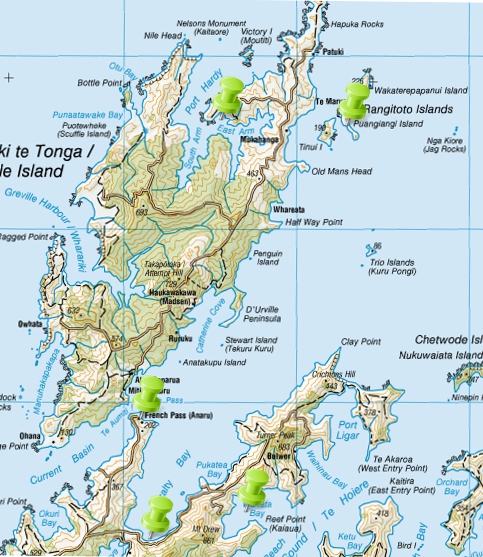
The island is part of the Cook Strait Ecological District- think wind and salt. Islands include: Takapouwera/ Stephens; the Rangitotos- Wakaterepapanui, Puangiangi, Tinui; Nga Kiore/ Jags; Kuru Pongi/ Trios; Nukuwaiata and Te Kakaho/ Chetwodes; Titi; Mana; and Kapiti. Add the northern tip of Rangitoto Ki Te Tonga/ D’Urville, Capes Lambert and Jackson, the exposed headlands of Arapawa and the Port Underwood coast, and the coastline from Wellington to Kapiti. The mainland areas and D’Urville and Arapawa carry pest mammals, but all of the other islands have either always been pest-free or have had pests eradicated. Occasional incursions have been reported on many of them. Puangiangi is important to the ecological restoration of the other Rangitoto Islands, and vice versa given how close they are to one another. Puangiangi’s nearest other neighbours are Takapouwera and Kuru Pongi, which to a greater or lesser extent are seabird islands. I’ve previously discussed the place of seabirds as keystone species and to state the obvious we were always going to see Puangiangi as a seabird island. What level of intervention to achieve this is desirable?

Level 1: doing nothing apart from keeping pests away

kohekoheeaten

The island would be likely to re-vegetate rapidly, but forest development and health would be limited by grazing. Weed species such as pines and macrocarpas would spread out and might dominate except in those areas already with mature forest. New weeds might arrive and establish. The weka would probably prevent seabird establishment and they would limit growth of the reptile population. To state the obvious, we would have only the limited range of birds, lizards and invertebrates that were already there, plus one or two self-introductions. The outcome would be a modified Cook Strait ecosystem.

Level 2: Level 1 plus removing sheep, weka and weeds and keeping it that way

Sooty1aThis option would allow seabirds to establish, and the forest would over time regenerate to what it would have been, minus any lost taxa. The populations of the existing animals plus any that could get themselves there would increase as habitat improved. The outcome would be a fully functional seabird island typical of Cook Strait.

Level 3: Level 2 plus restoration and translocation

robinThe reintroduction of species not on the island but which should be, gives an ecosystem rather close to what it would have been before humans and pests came along. If threatened species were included in translocations, it would help their security by giving them an additional site.

Level 4: A refuge

IMG_0284_1xThe island could be made available to house acutely threatened species, possibly at some detriment to an ecological restoration intended to provide a typical assemblage of plants and animals.

Preferred Intervention

The island’s size, location, security of tenure and good likelihood of being able to stop it filling up with pests again, convinced us that the highest-cost option, Level 3, was too good an opportunity to miss. We were able to formulate our goal pretty easily and to state the obvious, we propose “to return Puangiangi to a state that most closely resembles a fully functioning, Cook Strait seabird-island ecosystem in pre-human times”.

An earlier article talked about our approach to restoration of the forests and shrublands, and to support this our plan includes how to reduce the risk of a fire, which would be the single biggest threat. Realistically we can’t fight a fire except perhaps around the house, but we have a total ban on open fires and smoking.

Also integral to the goal is having  a proper biosecurity plan and all visits involve bag and equipment checks to reduce the chance of assisting pests to arrive. Unfriendly signs discourage trespassers and mitigate the attendant risk of bringing pests ashore. The island’s title extends to the waterline and there is no foreshore reserve or Queen’s Chain, so landing is able to be prohibited.

As for species reintroductions, we have made lists of birds, lizards and invertebrates based on what is found or should be found on the other relatively unmodified islands in the area. Our thinking about seabirds is described in a separate article. Land bird species that were missing in 2012 and might have been expected to be there include tui, bellbird, brown creeper, tit, robin, kakariki, fernbird, kaka and saddleback, not all of which might be a good idea to reintroduce. Lizards initially identified as candidates included spotted skink, speckled skink, Duvaucel’s gecko, striped gecko, and Marborough green gecko. Tuatara and frogs might also be expected to have occurred there. Missing invertebrates could include Cook Strait giant weta and ngaio weevil.

I hope that doesn’t read like a shopping list to establish yet another zoo masquerading as an ecological restoration. The emphasis is on commoner species which would have been present on the island, not some hodge-podge of threatened species based on the “I want” attitude, to which DOC appears to acquiesce all too often.

It’s worth noting that our goal is also consistent with DOC’s objectives for the region, as expressed in their Nelson-Marlborough and Island management strategies. It also fits in with the Department’s aims for management of individual species.

Although we did not look seriously at Level 4, a refuge for acutely threatened species, the island would probably be able to support small numbers of, say, kiwi, takahe or orange-fronted parakeet. We figured however that there were better opportunities to provide a long-term secure site for such animals. For example, although several pairs of takahe would thrive on the pasture lands, we see the grass reverting to forest over the next few decades, thereby displacing takahe. We did see a role for Puangiangi as emergency accommodation though. We made DOC aware of this and indeed the recent discovery of mice on Maud/Te Hoiere meant the island hosted some refugees from there.

We think we can get rid of the weeds and do all of the species translocations in ten years. The other tasks, not requiring large one-off efforts but more steady background work like maintaining the predator-free state, attracting seabirds, catching weka, keeping up biosecurity and fire measures, engaging with the owners and administrators of the other islands in the group, maintaining the infrastructure on the island, reviewing the management plan and keeping records of progress, will carry on, to state the obvious.