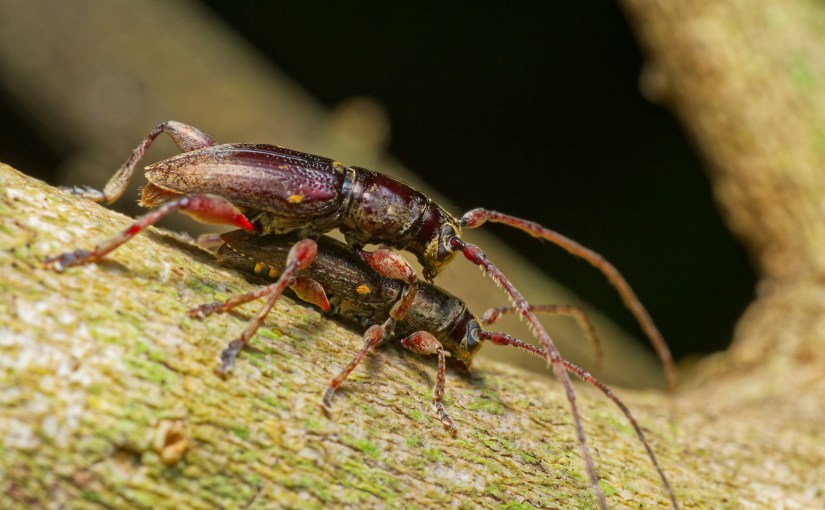
These animals are about 10 mm long and are just one of around 180 species of longhorn beetles in New Zealand. Longhorn beetles are named for their very long antennae. James Tweed on iNaturalist assigned the genus and suggested griseus as the likely species. It was named back in 1775 by Fabricius, who travelled from Copenhagen to Britain regularly and studied the collections of Joseph Banks among others, so the earliest scientific collection of this beetle was on Cook’s first voyage.
Xylotoles is a mainly New Zealand genus and species griseus is native here and widely distributed around the country, but it also showed up when a fig tree was felled in Devon in 2014. I’m not sure how that means it gets to be called the Fig Longhorn if it was collected here in the 1700s.
Longhorn beetles feed on flowers, leaves and bark, and the grubs tunnel into live or dead timber. Some species are regarded as pests because of this. Longhorn beetle grubs, including huhu of course, are widely eaten by people around the world.
This isn’t the only longhorn beetle on Puangiangi and another quite distinct one is coming up soon. Apart from the flightless, threatened species like giant weta and some of the Anagotus weevils, these articles won’t cover species of outstanding significance. Rather, the animals will be documented as I photograph them and help to build a picture of the commoner invertebrates on the island. On that note, Ian Millar summarised the insect and spider fauna as being like a subset of that on adjacent D’Urville, save for species more often found in beech forest, which Puangiangi lacks.
 Fauna Recovery New Zealand