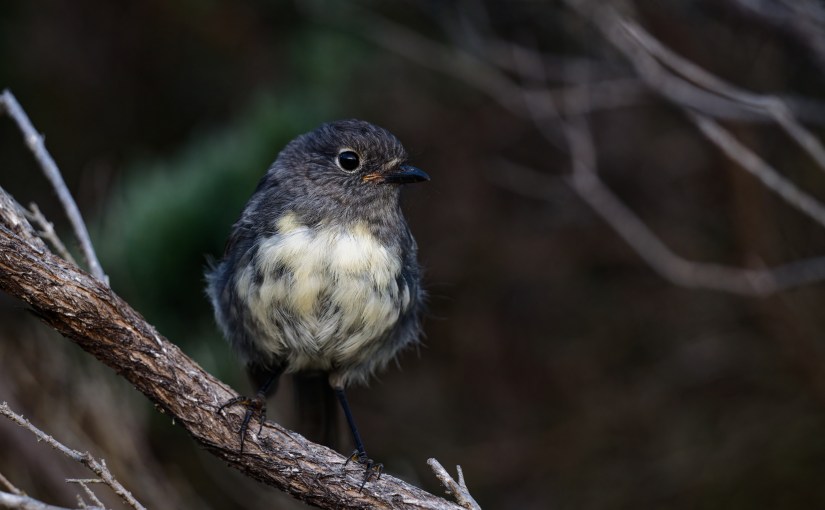
We moved 29 South Island robin from nearby Te Kakaho back in March and August 2013, so why so long to write it up? Laziness for sure, and reticence, lest the translocation dwindle away to a failure over time.
Right from the beginning of this project we thought robin would be an obvious candidate for reintroduction. They would certainly have been present before the arrival of rats in the 1800s. Peter proposed that Tinui of all the Rangitoto group of islands might be the best place to let them go as it had more forest cover than Puangiangi or Wakaterepapanui. A rep for the Tinui owners reckoned we should go with Puangiangi and presciently observed that they would end up on Tinui also in fairly short order anyway.

The project was endorsed by Ngati Kuia and Ngati Koata as gifting and recipient iwi respectively, and most of the birds were caught in August 2013 by Peter, Willie Cook, Ruby Collier, Bill Cash and Katrina Hale. Ros Batcheler who caught in March (which was mostly about kakariki rather than robin) was on hand to meet the birds, the big Ngati Koata welcome led by (the late) Joe Paul having been completed in March. Most birds were released centrally while Peter and Ruby had a quick trip down to the south to release three pairs in a piece of forest we have since dubbed Robin Bush. Free boat transport for birds and people was provided by (the late) Danny Boulton.
Courtship feeding was likely observed during the week after release, and three nests and two fledged young were seen only two months after the bigger release. A reasonable number of the original 29 have been seen over the years but we can’t really say what percentage of them formed the founder population given the difficulty in surveying all likely habitat. Two of the founders were still around in winter 2021 and it has always been a pleasure to see an old friend (minus the odd colour band) come up close to see if we are edible or will find some food for them. One of these founders is most often seen when we are weeding an area near Robin Bush, on a steep slope with very tight vegetation. It’s nice to see the elderly banded robin pop up in your little bubble when you are surrounded by a dense, scratchy botanical garden with visibility of only a couple of meters in any direction. Robin certainly add to people’s enjoyment of the island- if you don’t already know, they are confiding and aggressive. They think nothing of jumping on to your boots and picking at the laces, and I have had to shoo one off of my head repeatedly as it attempted to harvest any remaining hairs. They like to collect bugs from a scrape made with a boot, but they put paid to a favourite party trick of showing guests the pile of geckos sheltering between old sheets of corrugated iron when one quickly showed up and started scoffing the smaller geckos.
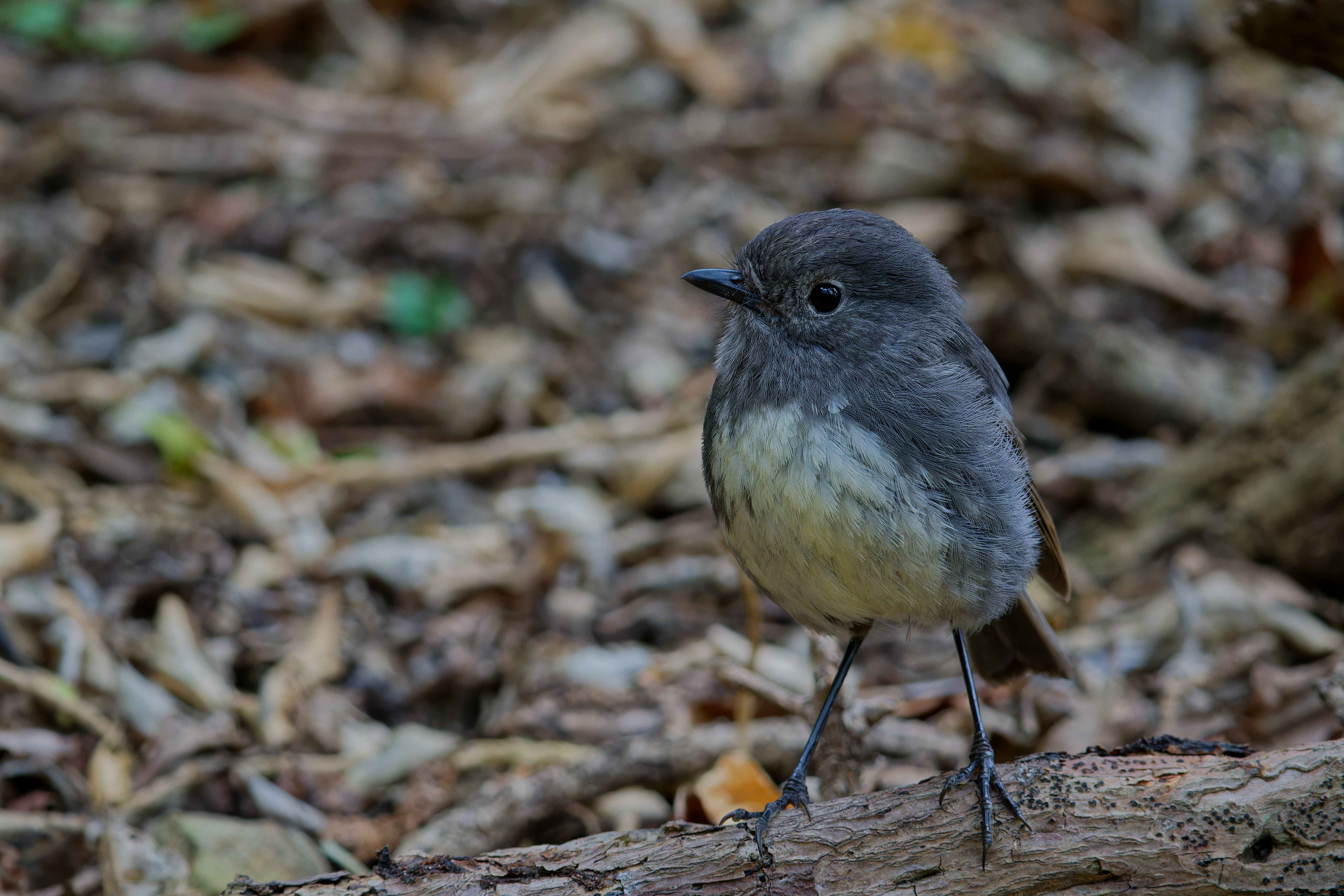
Numbers increased very strongly in the southern third of the island, but with very few being seen in the northern third until recently. In the central third around the house and nearby forest and shrublands, numbers initially built up quite well, yet we then appeared to witness two cycles of local extinction and recolonisation there. This aspect of the reintroduction made me the most nervous. Did the arguably more open forest structure allow falcon to take them under the canopy? Was there something toxic in the old rubbish dump (which we have cleaned up as best we can)? Did the larger population of kereru there compared with the rest of the island lead to disease transmission through the water supply (I did see an apparently OK robin go on to expire by the water trough a mere 15 minutes after I first saw it)? Or were we just seeing what happens in slightly less favourable habitat when food runs low seasonally? On the last point, Lynn Adams has noted on Mana over the other side of the Strait, that robin numbers go through frequent peaks and troughs, with good breeding yet apparently low survival beyond a season or so. The most obvious explanation would be that the less well established forest on Mana lacks enough food say in a dry autumn. In Wellington harbour, translocation of robin to Matiu Somes failed over a few seasons, despite breeding being observed. If there was a problem on Puangiangi it seems to have fixed itself and over the last couple of years robin have again become very common in the central area.
As of now, robin are common in the established forests and abundant in the regenerating shrublands of the southerly two-thirds. They have even colonised the heavier tauhinu scattered in the rank pasture, and are moving north, where they are now commonly seen.
Robin are probably at carrying capacity over a good part of Puangiangi. Bill Cash, who was the main force behind bird reintroductions to the almost identically-sized Motuara in Queen Charlotte Sound, estimated the robin population there at 300-600. We might be looking at a similar number on Puangiangi fairly soon. They could also easily be seen on Tinui by autumn 2016 (Colin Miskelly has documented several other examples of robin colonising islands by making sometimes quite long flights over open water; the distance to Tinui was probably not a particular challenge). A single bird was also seen on Wakaterepapanui to the north in spring 2021. I think it’s time to call Success on this one.
 Fauna Recovery New Zealand