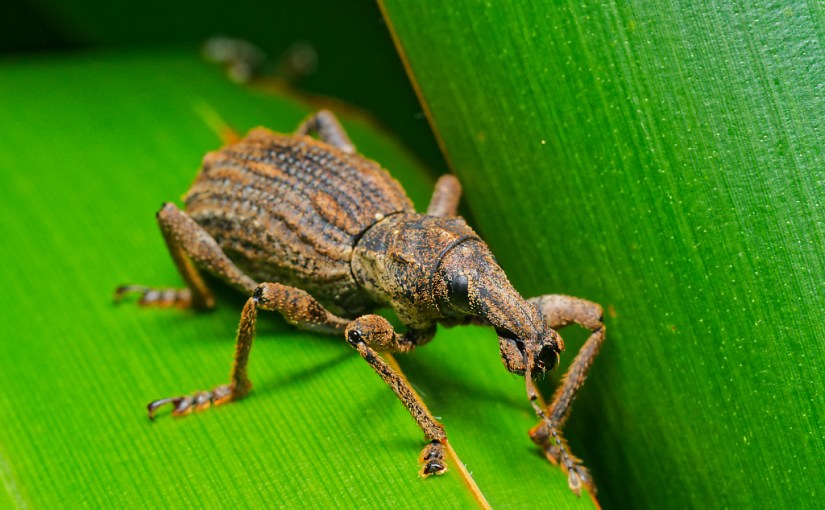
Anagotus fairburni
We saw the characteristic feeding sign of flax weevil on Puangiangi the day we first arrived but it took until 2013 to see one. Ecologist (the late) Geoff Walls gets the credit for that.

These weevils are quite large (20-25 mm) and can’t fly. They are now a threatened species and are mostly on predator-free islands.

It’s interesting that at least some of them survived on Puangiangi during the rat years. They are now most likely at carrying capacity and the population is healthy enough that some of them were translocated to Long and Motuara in 2021. Hopefully those translocations succeed without a repeat of what happened on Mana. A 2004 translocation from Maud Island went all too well, with the exploding flax weevil population wiping out much of the flax on Mana. It’s suggested that some unknown parasite that normally keeps numbers in check did not make the trip with the founder weevils.
As you can see, I’ve taken up photographing some of the small critters on Puangiangi. At least twice so far I’ve unknowingly photographed tiny mites on some insects, only seeing them once I edited the photos, but not so far on flax weevil. They are likely being parasites rather than just passengers. Entomologist Ian Millar confirms this is pretty common with many insects having mites. Does a mite specific to flax weevil have anything to do with what happened on Mana?


Flax weevil are one of the charismatic large insects on Puangiangi. I’ll also be celebrating some of the lesser known, common insects and spiders once I get good photos.
**Immediately this article went out, I heard from the manager of Patuki Station on D’Urville. This is where flax weevil became known to science in 1931. The feeding sign or something very close to it is still there, but recent searches have not turned up any animals.
**Expert on large weevils, Mark Anderson, got in touch to say that the translocations to Long and Motuara are looking promising. At a release site on Long that he was able to visit at night, the weevils have spread out about 100 m. The other release sites on Long and Motuara seem to have some feeding sign and await a closer look.
Discover more from Fauna Recovery New Zealand
Subscribe to get the latest posts sent to your email.
 Fauna Recovery New Zealand
Such a beaut article Barry. I’d love to hear from folk familiar with other weevil islands. Particularly whether there is substance to the story about the limiting impact of parasites. Also, whether there are other examples of these big weevils surviving with Norway rats but not ship rats – apparently not on D’Urville.
LikeLike
Both Ian Millar and Mark Anderson have seen a taupata weevil or something very like it on the island. If we have two of the big weevils, it must be very likely that ngaio weevil is there too despite not showing up so far. Re Norway and ship and their relative effects on things, I wonder if it is just as simple as to how much biomass of susceptible animals there was before a rat of any sort showed up, and how long it took to get rid of the rats in a given location, rather than any nuance about how far from the ground a given rat species feeds???
LikeLike